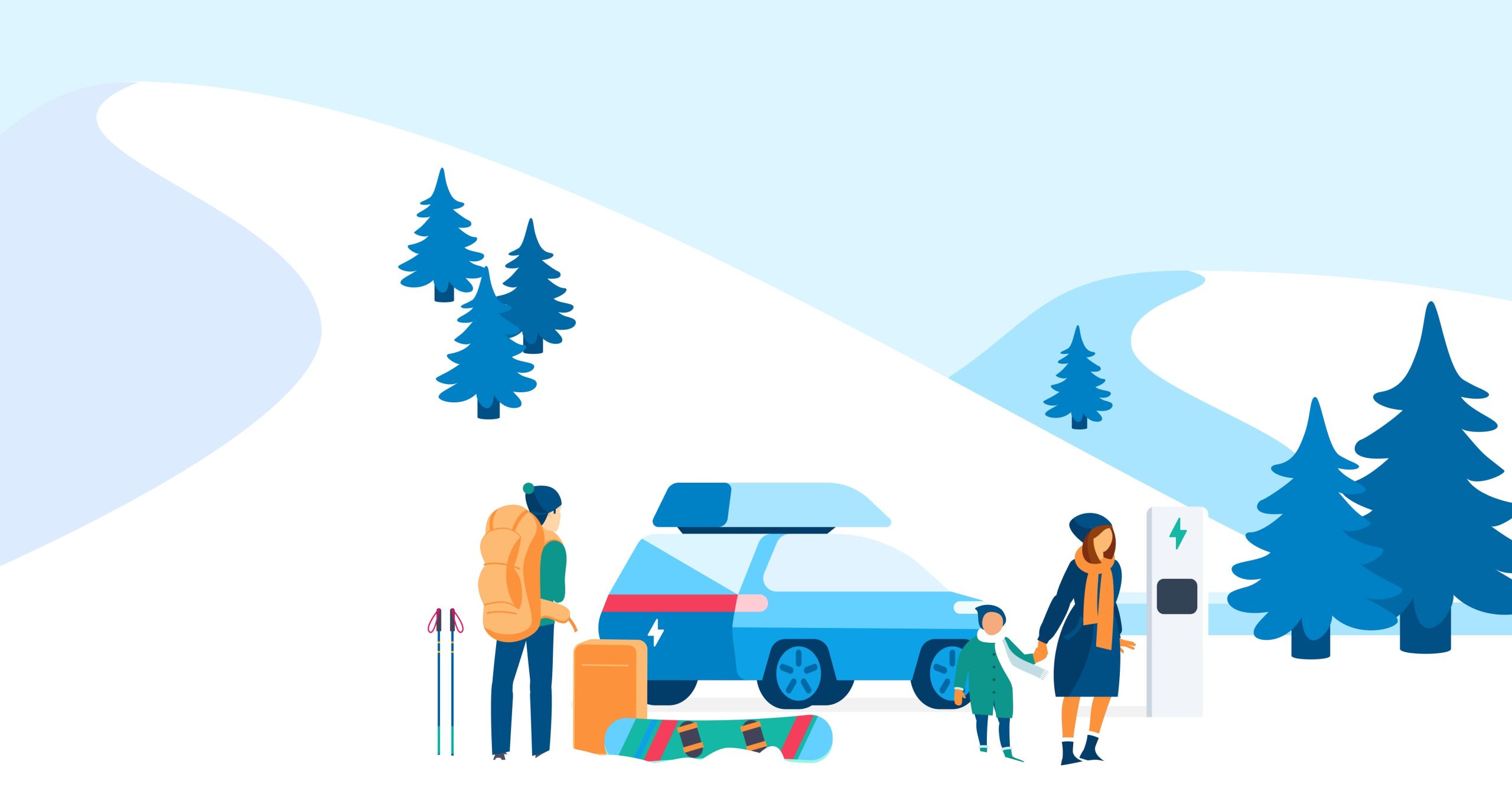
Yes, you can, and more easily than you might think! With improvements in electric vehicle range, the expansion of charging points along main roads and at ski resorts, as well as route-planning tools such as Chargemap, getting to the ski slopes in an EV is entirely possible. Provided you prepare your journey properly, anticipate the impact of cold weather, and know how to charge efficiently in the mountains.

Key Takeaways
- Travelling to ski resorts in an EV is possible.
- Cold weather can reduce range, but this can be anticipated.
- Careful route planning is essential.
- Charging infrastructure at ski resorts is gradually expanding.
- Winter tyres —and snow chains if necessary— are essential.
Is it really possible to travel to ski resorts in an electric car?

Just a few years ago, driving to the mountains in an electric car could feel like an obstacle course (limited range, very few charging points at resorts, etc.). Fortunately, today the situation has changed significantly. Most recent electric vehicles now offer a real-world range between 300 and 500km, which is more than enough to reach a ski resort with one or two well-planned charging stops along the way.
The main roads leading to major mountain resorts are now well equipped with charging points.
How to properly plan your journey in an electric car
Before hitting the road, it’s important to know the real-world range of your electric car to avoid any unpleasant surprises. Not all electric vehicles offer the same range. For example, the Tesla Model Y has a range of 455 to 622km on a single charge, according to the WLTP standard.
Anticipating charging times
Journey time and route choice also depend on the location of charging points. It is therefore highly recommended to check your route before setting off, in order to identify the charging stations available along the way. You should also estimate how long each charging stop will take so you can plan your entire journey accordingly. For example, by stopping at a service area with charging points for your lunch break, you can kill two birds with one stone by recharging both your EV battery and your own batteries!
Plan your route with Chargemap

Set off with peace of mind by using the Chargemap route planner to create the ideal journey based on your vehicle and your charging preferences. Simply enter your departure point and destination, along with your initial battery level and the desired level on arrival. A range of settings and parameters allow you to fine-tune and personalise your route.
By doing so, you’ll travel with a clear itinerary and backup charging options.
Find out more: Chargemap route planner: how to use it properly?
Keep a safety margin
In winter, it’s advisable to keep a larger safety margin than in summer. Plan to arrive at each charging point with at least 15–20% battery remaining, especially in mountainous areas.
How does cold weather affect an electric vehicle’s range?
You also have to take into account the effects of cold weather on your vehicle. In winter conditions, you may notice a slight reduction in range in an electric car, but it is neither systematic nor solely due to the cold. On recent models, thermal management systems significantly limit the impact of low temperatures on the battery.
The additional energy consumption in winter is most often linked to:
- use of heating and comfort features,
- mountainous terrain and elevation changes,
- winter-specific driving conditions.
Conversely, downhill sections allow energy to be recovered through regenerative braking, which partly compensates for the climbs. With appropriate driving and good preparation, a winter journey to a ski resort in an electric car remains perfectly manageable.
Being properly equipped for a winter journey in an electric car
If you’re planning to go skiing in French resorts, we recommend checking the road and environmental regulations in force, which vary from one country to another. In France, pursuant to the Mountain Law, it is compulsory to use winter tyres, all-season tyres, snow chains or snow socks in many departments between 1 November and 31 March.
In Germany, winter tyres are not mandatory during a fixed period or in specific geographical areas. The requirement is circumstantial, depending on weather conditions.
In the UK, although there is no law requiring drivers to fit winter tyres or snow chains at a specific time of year or under particular conditions, they are recognised as safer in cold, icy, or snowy conditions because their rubber compound and tread are designed for low temperatures and improved grip.
You can find our full article on the use of winter tyres for electric cars.
You may also want to take along other useful equipment, such as a charging cable (required for AC charging points), an ice scraper, gloves, or a windscreen cover to protect your vehicle.
Best practices for charging on the way to ski resorts
During winter holiday departures, motorway charging infrastructure is under particularly heavy demand, especially before the final climb to ski resorts, where charging points are still quite limited.
To keep charging flowing smoothly and avoid queues, here are a few best practices that all EV drivers can adopt:
- Plan your journey in advance by identifying several alternative charging points to avoid congestion at the most popular stations
- Opt for off-peak charging times to avoid the lunchtime rush or peak traffic periods
- Optimise your charging by following the 20–80% rule: there’s no need to charge to 100%, as the final stage is much slower and unnecessarily occupies the charging point
- Unplug as soon as you have enough charge and free up the space for other users
Anticipate winter conditions: cold weather can affect range and slow down charging, so it’s best to set off with an extra safety margin.
These simple habits help distribute demand more evenly across the network and make journeys smoother for everyone. Charging infrastructure continues to expand, but cooperation between EV drivers is essential to ensure a seamless journey to the top!
Optimising the use of your electric car
On long journeys, range is the bottom line, especially in winter and in mountainous areas. To reduce your vehicle’s energy consumption, here are a few easy tips to put into practice:
- Adopt eco-driving by maintaining a moderate speed. For example, it’s advisable to keep your speed between 100 and 110km/h on motorways to reduce energy consumption
- Preheat the interior shortly before departure, if possible while the vehicle is still plugged in. If you set off straight after charging, this can also save a few valuable kWh, as the battery will already have been “warmed up” during charging
- Avoid excessive use of heating to save energy and make use of regenerative braking. This helps maximise your vehicle’s range
- Recharge in good time and avoid dropping below 10% battery as much as possible. Keep a safety margin in case you need to find an alternative charging point
- Charge the battery to around 80%. Beyond this level, charging becomes increasingly slow, making it inefficient and keeping the charging point occupied longer than necessary
Preparing for charging at your destination
In general, winter sports resorts try to limit the number of parking spaces to prioritise pedestrians and keep streets clear. As a result, it’s important to plan your charging solution in advance.
Some residences or hotels offer allocated parking spaces and may provide charging points for their guests. Gather information ahead of time to choose the most suitable option.
You can also check whether there are charging points near your accommodation. To do so, simply use the Chargemap app to locate nearby charging stations.
Bonus: List of French ski resorts equipped with charging points
Val d’Isère (Savoie, France)
- Several charging points installed in the resort’s car park.
- Charging available in both AC and DC.
- Compatible with most electric vehicle models.
Les Arcs (Savoie, France)
- Charging points available at various levels of the resort (Arc 1600, Arc 1800, Arc 2000).
- Rapid charging points allow efficient charging even in the extreme cold.
- Charging points compatible with the multi-network Chargemap Pass.
Chamonix-Mont-Blanc (Haute-Savoie, France)
- Several charging points in the town centre and the ski area car parks.
- Infrastructure suitable for electric and plug-in hybrid vehicles.
- Some partner hotels and chalets also offer private charging points for their guests.
Megève (Haute-Savoie, France)
- Charging points located in the resort’s covered car parks.
- Free charging for guests of certain partner hotels.
- Compatible with the main European charging networks.
Serre Chevalier (Hautes-Alpes, France)
- Network of charging points deployed across the entire ski area.
- The resort is committed to energy transition, with some solar-powered charging points.
- Access to charging points is facilitated via the Chargemap app.
How to know if a resort has charging points
- Check directly on the Chargemap app.
- Visit the official website of the ski resort.
- Contact the local tourist office for the latest updates on available infrastructure.
And what about you? What are your best tips and tricks for going on a winter sports trip in an electric car? The Chargemap team wishes you a safe and enjoyable journey in your electric vehicle ⛷️.

To plan the ideal route by electric car,
download your Chargemap app.