Understanding the terminology related to electric vehicle (EV) charging can be challenging, especially for new drivers. Whether you're a beginner or an experienced EV owner, this article will help you grasp the essential concepts to choose the right charging solution and optimise your journeys. From the differences between charging zones, stations, and points, to the various types of connectors, and practical tips for charging your electric car, we're here to break down the basics of EV charging and refresh your knowledge!

Key Takeaways
The basics of EV charging
Charging zone, station, or point: what's the difference?
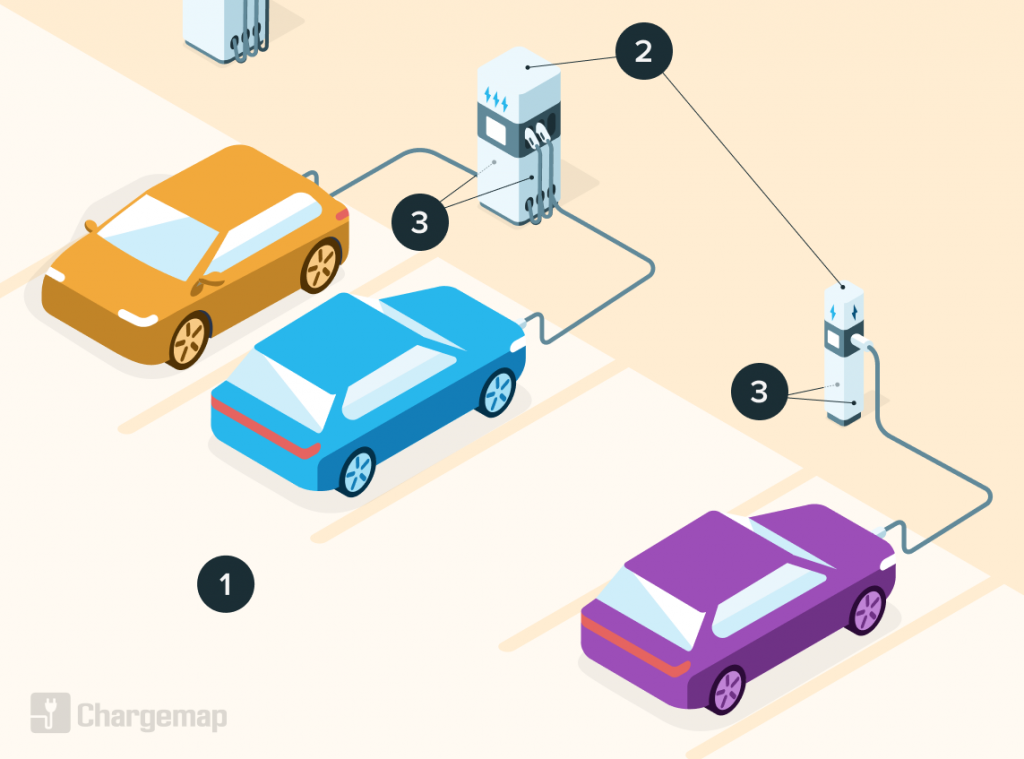
- Charging zone: a location equipped with one or more charging stations. Examples include supermarket car parks or motorway service areas.
- Charging station: a piece of equipment connected to an electrical supply that enables the charging of one or multiple cars, depending on the number of charging points it has.
- Charging point (EVSE): a single charging outlet that allows just one electric vehicle to charge at a time and is usually paired with a dedicated parking space.
Number of sockets ≠ Number of charging points
A charging station that is equipped with several types of sockets and/or tethered cables with connectors (as is the case for fast charging) does not necessarily mean it has an equivalent number of charging points. Different socket formats are provided to suit various electric vehicle models.
Simply put, a single charging point (EVSE) may have several sockets but can only charge one electric vehicle at a time.
Example: A station with two charging points might each offer a domestic socket and a Type 2 socket. While there are four sockets in total, only two vehicles can charge simultaneously at this station.
Simultaneous charging = lower power output?
It's common for a charging station to offer two charging points. So when two vehicles charge at the same time on the same station, the available charging power may be shared between them.
Let's consider a theoretical example:
- A charging station provides 22 kW of power in alternating current (AC).
- Two vehicles connect to the station.
- The station distributes the available power between the two points, supplying 11 kW to each vehicle.

Be aware, however, that all of this is very theoretical.
Bear in mind that when you connect to a station with two charging points already occupied by another vehicle, the charging speed will likely be reduced.
Additionally, remember to consider other factors that can impact the charging power and time for your electric vehicle.
Public charging stations are generally equipped with multiple types of connectors to support a variety of compatible vehicles. What are these connectors? ⬇️
Connectors and sockets
- Type 1: an older standard, it is now rarely used in Europe and is primarily found on older electric vehicle models.
- Type 2: the most common standard in Europe for AC charging. It supports charging up to 22kW in three-phase and is the type of connector most frequently found at public charging stations.
- Combo CCS: a connector that combines a Type 2 socket with an additional connector for fast DC charging. This is the standard for most European electric cars that support fast charging.
- CHAdeMO: a Japanese standard designed for fast DC charging. Its use is declining in Europe as Combo CCS becomes more prevalent.
- Domestic socket: suitable for slow charging at home but limited to 2.3kW. Prolonged use can pose risks to your electrical installation.
- Heavy-duty power socket: an alternative to the domestic socket for home charging, offering improved safety and slightly higher power (up to 3.7kW).
↪️ Check out our dedicated article on the different types of sockets and connectors for charging your electric car.
The different charging modes
There are four main charging modes for electric vehicles.
Mode 1: refers to slow charging directly from a standard domestic socket. This mode is not recommended for EV charging as it is too low-powered and lacks adequate safety measures.
Mode 2: also uses a domestic socket, but with the addition of a reinforced socket. Unlike Mode 1, this method is safer and slightly faster. To prevent the risk of overheating and to increase current intensity, an electronic control box is required to regulate the charge.
Mode 3: the ideal and safest solution for home charging or use in private spaces. This mode involves the installation of a wall-mounted EV charging station, which can deliver twice the power of a standard domestic socket. In Mode 3, the station can provide up to 22 kW of power.
Mode 4: refers to public electric vehicle charging infrastructure available in public places, such as supermarket car parks or motorway service areas. Mode 4 delivers very high-power current. These public charging stations typically have a charging capacity of 50kW, or even more (150 or 350kW).
Key technical concepts
- kW (kilowatt): measures the power of a charging station, determining the speed at which your vehicle can be charged.
- kWh (kilowatt-hour): a unit of capacity: what a battery consumes or stores.
- Alternating current (AC): the type of current supplied by standard charging stations and domestic sockets. An EV battery can only store electricity as direct current (DC), so a converter under the bonnet of the vehicle converts AC into DC before it's stored in the battery. This conversion is what increases charging time. AC charging stations generally offer normal to fast charging (up to 22kW) but can sometimes reach up to 43kW.
- Direct current (DC): used in rapid and ultra-rapid charging stations delivering up to 350kW. Here, the station is directly equipped with a powerful AC/DC converter, allowing it to deliver direct current and charge the vehicle's battery instantly.
Practical tips for charging on the go
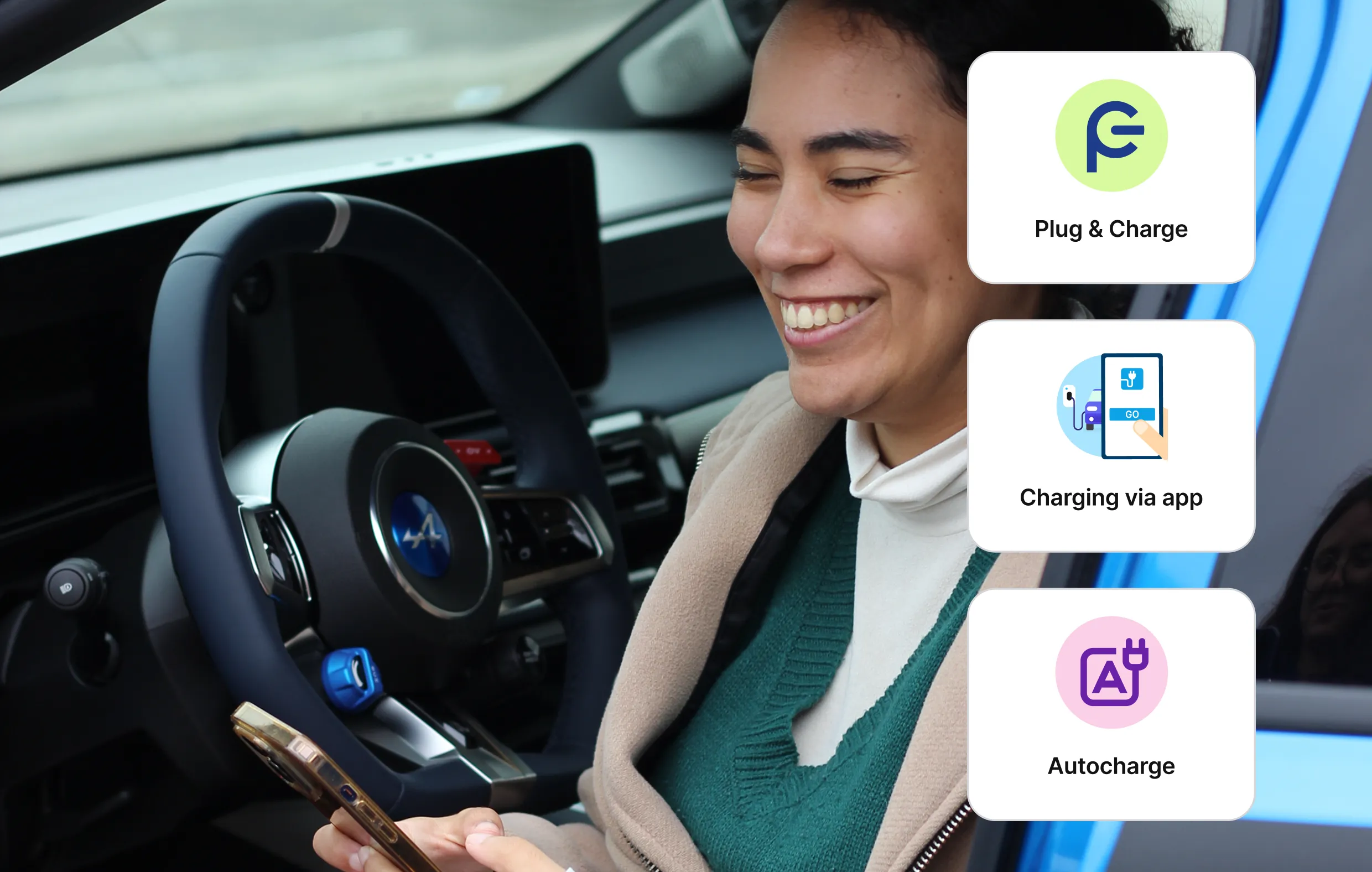
Get a charging card: a charging card allows you to activate and pay for charging at public charging stations. Several charging cards are available on the market, offered by mobility operators or charging networks.
The Chargemap Pass, a multi-network card, lets you charge at over {{charging-points}} charging points in 19 European countries. No more juggling between several cards to charge at public stations!
Use a mobile app: useful for locating charging stations while travelling and planning routes with your electric car, but that's not all. It should also let users:
- Quickly find the nearest charging stations
- Check the real-time availability of charging stations
- Plan optimised routes for charging your electric car
- View pricing and available connector types
Take advantage of the Chargemap application. ⬇️


Understand public charging pricing methods. The most common are:
- Per-kWh billing. Used by many major national networks (Electra, Ionity, Fastned, etc.).
- Time-based billing (per hour or minute). This type of billing is more common on smaller local networks. The price is calculated per minute or in time blocks (10, 15, 30 minutes...).
- Flat-rate billing. Some networks offer a flat rate for a set period, usually overnight.
Charging prices can vary significantly from one network to another. They depend on factors such as the power of the station, the operator, the time of day, and more.
↪️ Find out more about the different aspects of EV charging prices.
Check prices before charging: before charging your electric vehicle, it's recommended to always check the charging price directly in the Chargemap app.
Understanding the terms related to charging is essential to make the most of your electric car. If you have any questions or would like to add to this guide, share them with us in the comments below!