Driving an EV and wondering how it actually works once you're standing at the charging point? Finding an available charging point, authenticating yourself, starting the session: the principle is simple, but a few pointers help you find your way, especially when you're just starting out.
By the end of July 2026, there were over 2,150,000 fully electric cars on the road in the UK (Zapmap), and public charging points play a key role for these drivers on the move. Here's a clear picture of how they work, how to use them day to day, and some tips for stress-free charging.

Key Takeaways
- A public charging point is open to everyone, whether on public roads or at a private location open to the public (car parks, shopping centres, petrol stations).
- There are three types of charging points: slow (AC, up to 22kW), rapid (DC, up to 100kW) and ultra-rapid (DC, up to 350kW), depending on your needs and your journey.
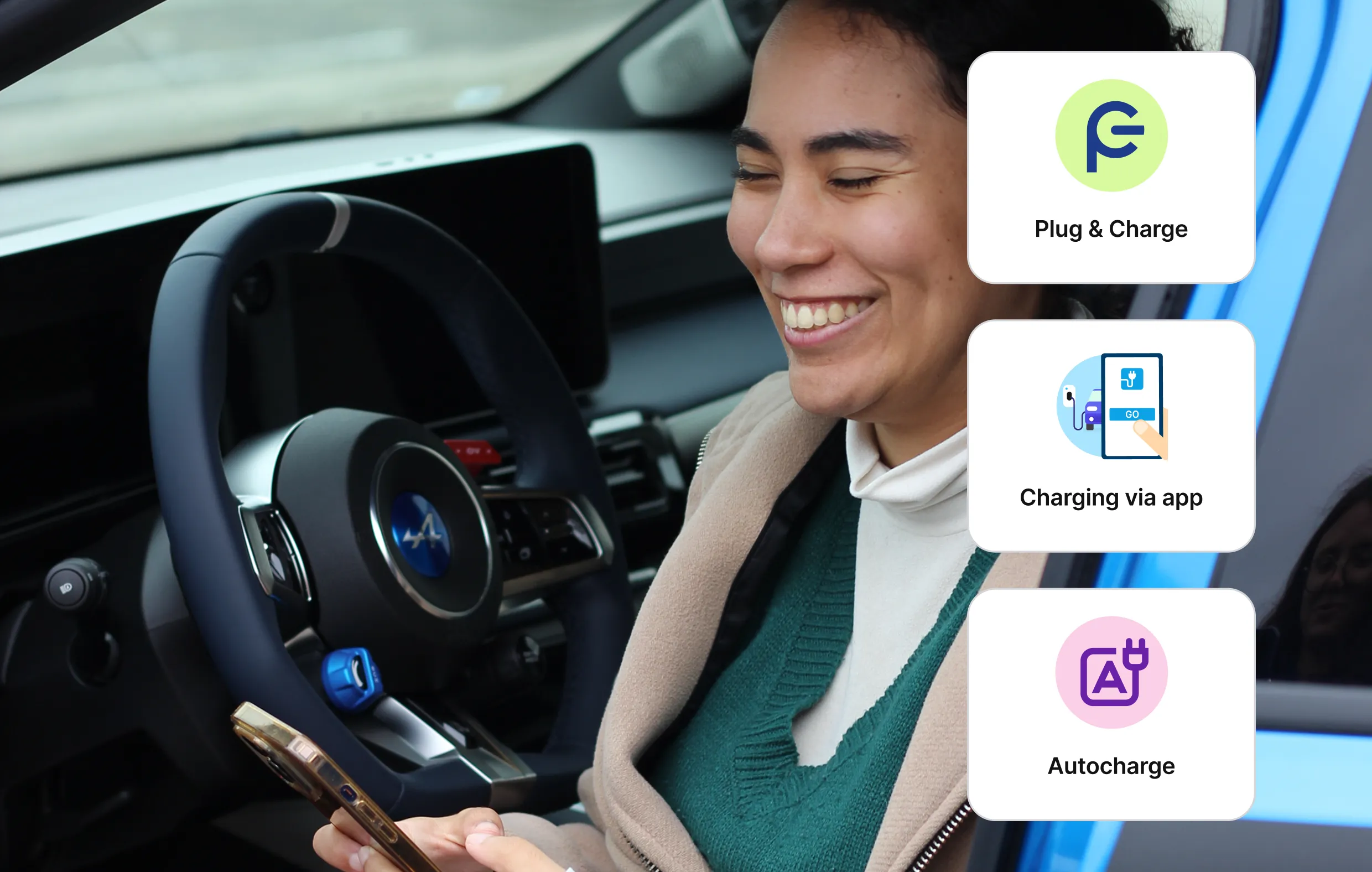
- Authentication works in several ways: a charging card such as the Chargemap Pass, a mobile app, Autocharge or Plug & Charge.
- Prices vary depending on power, location and operator; with the Chargemap Pass, you automatically benefit from preferential rates on Super Partner networks.
What is a public charging point for EVs?
Public charging points for EVs are obviously essential for EV drivers. They allow them to charge their cars in complete safety while on the go. These charging points play a fundamental role in ensuring sufficient range for journeys, particularly over long distances. But what exactly is a 'public charging point'?
Definition and purpose
Public charging points are accessible to everyone. They are installed on public roads or in private locations open to the public (such as car parks, shopping centres, petrol stations, etc.), and allow for EV charging in complete safety.
There are several categories of charging points, depending on the power rating of the charge and the time needed to achieve full range. Public charging points, particularly rapid and ultra-rapid ones, ensure the continuity of long journeys without the inconvenience of slow charging.
Where can I find public charging points?
Public charging points are strategically located in areas where EV drivers can easily access energy when needed:
- Shopping centre car parks: you can charge your EV while you're shopping, allowing for slow but efficient charging.
- Motorway service areas: these charging points are ideal for long journeys, allowing drivers to get back on the road after a quick charging session in less than half an hour. Most motorway charging points are rapid or ultra-rapid.
- Public car parks in town: this type of charging point is practical for EV users living in town centres, who do not have the option of charging at home.
- Petrol stations: with the rise in popularity of electric vehicles, petrol stations are stepping up their game by adding more charging points, so there's no need to be jealous⛽.
Thanks to the Chargemap app, you can easily locate the public charging points that are available around you. You can check their availability in real time and consult other drivers' reviews to find out more. The app also allows you to filter charging points by power rating, cost and vehicle compatibility.
How does a public charging point for EVs work?
If you're new to driving an EV, understanding how charging points work is an important part of planning your journeys (and avoiding potential problems in the process). The steps to follow and the types of charging points are the first aspects you need to know about:
Types of charging points
Public charging points fall into several categories, mainly according to the power rating of the charge:
- Slow charging points (AC up to 22kW): these are ideal for prolonged stops, such as in shopping centre car parks or at offices. It can take between 4 and 8 hours to fully charge a vehicle, depending on the EV model.
- Rapid charging points (DC up to 100kW): widely used on motorway service areas and in high-density urban areas, these charging points can charge 80% of the battery in about 30 minutes. This type of charging point is perfect for long-distance journeys where rapid charging is required.
- Ultra-rapid charging points (DC up to 350kW): these charging points are particularly effective for very long journeys, with charging sessions taking between 20 and 30 minutes, on average, depending on conditions. Their speed depends on a number of factors, including:
- Your car model,
- Battery capacity,
- The current state of charge,
- Current weather conditions,
- The number of vehicles charging at the same time,
- The performance of the charging point and cable, etc.
These ultra-rapid charging points are compatible only with the latest generation of EVs equipped with batteries that can withstand such power ratings. They are mainly found on major motorways, so that drivers can get back on the road quickly. Find out all you need to know about fast charging!
Steps for using a public charging point
How do you use a public charging point? Here are the essential steps for efficient EV charging!
- Locate the charging point using the Chargemap app (it also allows you to check availability in real time and view user reviews of the charging point).
- Authenticate yourself using a charging card like the Chargemap Pass, via a mobile app, or directly through solutions such as Autocharge or Plug & Charge, which automatically recognise your vehicle. This will activate the charging point and start charging.
- Connect the cable: it's either already attached to the charging point, or you'll need to use your own cable, often supplied with your vehicle.
- Follow the progress of charging via the app or on the charging point's screen. Some charging points also allow you to see an estimate of the total cost.
- End the session by swiping your card again and disconnecting the cable. Make sure you end the session properly to avoid additional fees.
Also read: Do you need to charge your electric car every day?
💡 Tip
Before setting off on a long journey, always check the availability of charging points on your route, especially at peak times. Allowing an extra battery margin can also help you avoid running out of power if a charging point is already occupied or faulty.
🔎 Find out more: 9 dos and don'ts when charging on a public charging station
Cost and payment methods for public charging points
Charging costs vary according to a number of factors, including the power rating of the charging point (the faster the charging point, the more expensive it is), its location (charging points in towns and cities are often cheaper than those on motorways) and the network operator. Each operator applies its own pricing model, which may include several types of billing:
- Energy-based billing (kWh): this is the fairest method for users, as it reflects the amount of electricity actually consumed by the vehicle.
- Time-based billing: common for rapid charging points, the price is based on the length of time the vehicle remains connected.
- Fee-for-service charging: here a fixed amount is charged for each charging session, regardless of the duration or amount of energy used.
Charging points located on motorways are often more expensive because they require additional investment (site rent, maintenance, etc.). With the Chargemap Pass, you automatically benefit from preferential rates of up to -10% on Super Partner networks, selected by Chargemap for their quality and reliability. The Chargemap Club also brings together one-off promotions from partner networks directly in the app.
Chargemap allows users to check the rates before they start charging, via the app, and to adjust their budget according to the charging points available.
Payment methods
Electric vehicle drivers can pay for their charging in different ways:
- RFID charging card: the Chargemap Pass is one of the most convenient options for accessing over 1 million charging points across Europe. It allows payments to be centralised and avoids the complications associated with multiple charging providers.
- Mobile app: some charging points accept payment via mobile apps offering smoother management and the ability to track prices in real time.
- Bank card: at some charging points, particularly those on motorways, you can also pay directly by bank card. However, this option offers fewer benefits than solutions such as the Chargemap Pass.
Charging an electric vehicle at a public charging point is becoming easier all the time, thanks to the development of infrastructure. Whether in town or on the motorway, public charging points are now everywhere, letting you travel with peace of mind. Enjoy your electric journey!

Find public charging points on your journeys at a glance.
Download or update your Chargemap app.


We answer your questions
What's the difference between a rapid and a normal charging point?
Normal charging points, or AC (alternating current) points, are suited to long stops such as overnight or extended parking. Rapid and ultra-rapid charging points, using direct current (DC), charge your vehicle in record time, often in under 30 minutes, making them ideal for long journeys.
Can I charge my car at any charging point?
Most charging points are compatible with recent electric vehicles, but it's worth checking that the connector matches: Type 2 for AC charging points, CCS or CHAdeMO for rapid DC charging points. The Chargemap app lets you filter for charging points compatible with your vehicle to simplify your search.
How can I charge for free at a public charging point?
Free charging points still exist, but they're becoming increasingly rare, particularly in some shopping centre, local authority or company car parks. Chargemap makes it easy to spot them so you can plan your journeys accordingly. Find out where to find free charging points near you.