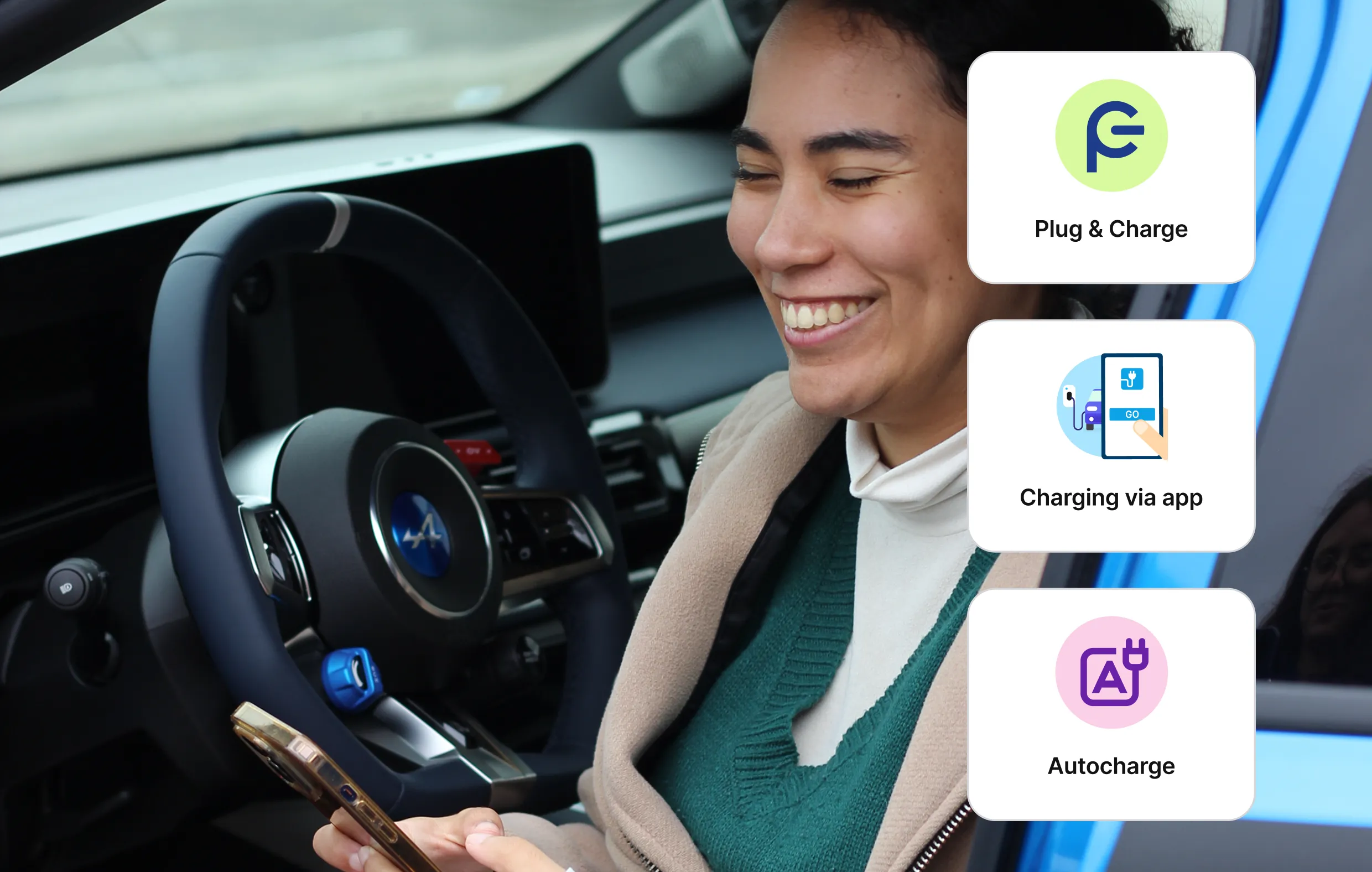
Ready to power up, but wondering how to charge your electric car efficiently and practically? Look no further! We'll walk you through the different charging methods, the types of charging points available, and share practical tips to make every charging session count. Whether you're at home or on the road, find out how to charge your electric car simply and practically!

Key Takeaways
- You can charge your electric car at home, at public charging stations, and at work.
- There are two types of charging points: slow charging (AC) and fast charging (DC).
- An app to locate charging points and a charging card are very useful for hassle-free charging on the go.
- Planning your electric car journey is essential to make the most of charging stops and avoid surprises.
Different charging methods
To make charging your electric vehicle (EV) as efficient and practical as possible, you need to know the different methods available. Let's start with home charging options.
Charging at home
For many EV owners, home charging is often the most practical option. You can charge via a standard domestic socket or a dedicated charging point for electric cars.
Standard domestic socket
The standard domestic socket, or conventional power outlet, is the most accessible way to charge your electric car. However, it also has its drawbacks.
- Advantages: Standard domestic sockets are available in almost every home. There is no extra cost if your electrical installation is already suitable.
- Disadvantages: A full charge can take up to 36 hours. Power is generally limited to 1.8 kW, which is much slower than other charging options.
Wall-mounted charging point
For those looking for a faster and more efficient option, a home charging point is ideal. A wall-mounted charging point is an excellent solution for speeding up your vehicle's charging. These units help avoid any hazards associated with charging your electric car at home.
- Advantages: A home charging point can deliver up to 22 kW, which considerably reduces charging time. Professional installation ensures safe use that complies with standards.
- Disadvantages: An initial investment is required for purchase and installation. You'll need to call in a qualified electrician.
These charging points use alternating current to charge vehicles. They're ideal for charging at home or at work.
Charging at public charging stations
For those who can't install a charging point at home or travel frequently, public charging stations are an excellent alternative!
Locating public charging points
Public charging points are increasingly common and can be found in various locations such as shopping centre car parks, motorway service areas, and public car parks. To easily locate these charging points, the Chargemap app is ideal! You can also charge at the best price at stations near you.
Types of charging points
Public charging points can be classified into two main categories: slow charging points (AC) and fast/ultra-fast charging points (DC).
- Advantages: There are many charging points available in urban areas and on main roads. Fast and ultra-fast charging points allow (on average) charging in less than 30 minutes to reach 80% battery capacity.
- Disadvantages: Some public charging points can be expensive, especially if pricing is based on time spent.
Understanding the types of charging points
Knowing your vehicle's charging capabilities is essential for choosing the best charging option. To avoid any disappointments, it's important to understand the different charging possibilities and be clear about power and charging time.
Slow charging points (AC) ⏳
These charging points use alternating current to charge vehicles. They're ideal for charging at home or at work.
Characteristics:
- Power: they offer power ranging from 3.7 kW to 22 kW.
- Socket types: they mainly use Type 2 (Mennekes) sockets.
- Location: these charging points are generally found in residential garages, company car parks, and public car parks.
Slow charging points are perfect for daily charging where time isn't a critical factor. They allow safe and efficient charging whilst you're at home in the evening or at the office during the day, for example.
Fast / ultra-fast charging points (DC) ⚡
These charging points use direct current for fast charging. They're commonly used on motorways.
Characteristics:
- Power: they offer power ranging from 50 kW to 350 kW.
- Socket types: they mainly use CCS (Combo) and CHAdeMO sockets.
- Location: these charging points are predominantly found on motorways, at service stations, and at large rest areas.
Fast charging points are ideal for long journeys where you need to charge your vehicle quickly. They allow you to recover a large part of your range in a short time, which is perfect for brief stops during your travels.
Want to know more about the practical side of charging your electric vehicle? Find out all about socket types in a simplified way!
Apps and tools to make charging easier
Mobile apps and charging cards play an essential role in making charging practical!
Mobile app for finding charging points
There are mobile apps that list charging points and help plan routes. That's the case with the Chargemap app! It also lets you estimate charging costs and find the best available options. Drivers can easily locate available charging points, check their compatibility with their vehicle, and estimate the associated costs of charging. This feature is particularly useful for avoiding unpleasant surprises and making the most of your journeys.
Charging card for electric cars
Charging cards also make life easier! For example, the Chargemap Pass is a charging card that gives you access to a wide network of charging points across Europe. It offers great convenience and advantageous rates. By using the Chargemap Pass, drivers can access numerous charging points without having to worry about the different payment methods of each operator. This greatly simplifies the charging experience, especially when travelling abroad.
Practical tips for charging
Making the most of your electric car charging requires good planning and using the right resources.
Before departure
Plan your route and identify potential charging stops. Use the apps mentioned above to find charging points along your route and have alternatives ready in case charging points are busy.
By planning ahead, you can anticipate any issues and ensure you'll always have a charging point available when you need one. This is particularly useful for long journeys where charging points may be less frequent.
During the journey
Use apps like Chargemap to find charging points on the road and avoid isolated charging points if you need a Plan B. For more tips, we explain how to avoid long queues at charging points. During your journey, it's also important to stay flexible and have alternatives ready in case of unexpected events. Journey planning apps can help you adjust your route in real time and quickly find available charging points.
Optimising charging
Wherever possible, charge at home during off-peak hours to save money. We give you additional tips for saving on charging your electric car.
If you're really pressed for time, you can use fast charging on long journeys to minimise stops. To best preserve your electric car's battery, only use fast charging points when necessary and occasionally.
Optimising charging therefore means reducing costs as well as extending your vehicle's battery life. Slow/moderate charging during off-peak hours is particularly financially advantageous and can easily be programmed with smart charging systems.
Charging your electric car may seem complex, but with the right information and tools, it becomes a simple and efficient routine! By understanding the different charging methods, the types of charging points available, and using apps and charging cards, you can make the most of every charging session. Remember to plan ahead and use optimisation strategies to make your electric car journeys as smooth and cost-effective as possible.
The entire Chargemap team wishes you safe travels in your electric car!